Conductive Level Switch vs Reed Float Switch: How to Choose
Oct 17, 2026Updated October 17, 2026. Reviewed by the Focusens Engineering Team.
| Conductive (electrode) switch | Float switch with reed contact | |
|---|---|---|
| What it senses | Current through the liquid between probe rods | A magnet in the float closing a reed contact in the stem |
| Liquid must | Conduct: minimums of 7.5 to 100 µS/cm | Float the float: minimum specific gravity 0.45 to 0.90, by float |
| Works in oil, fuel, distilled water | No (distilled water only with a special high-sensitivity relay) | Yes, with a float material rated for the liquid |
| Moving parts | None | The float |
| Typical failures | Scale on the rods, conductive foam, liquid too pure | Stuck float, iron particles, turbulence, welded contact |
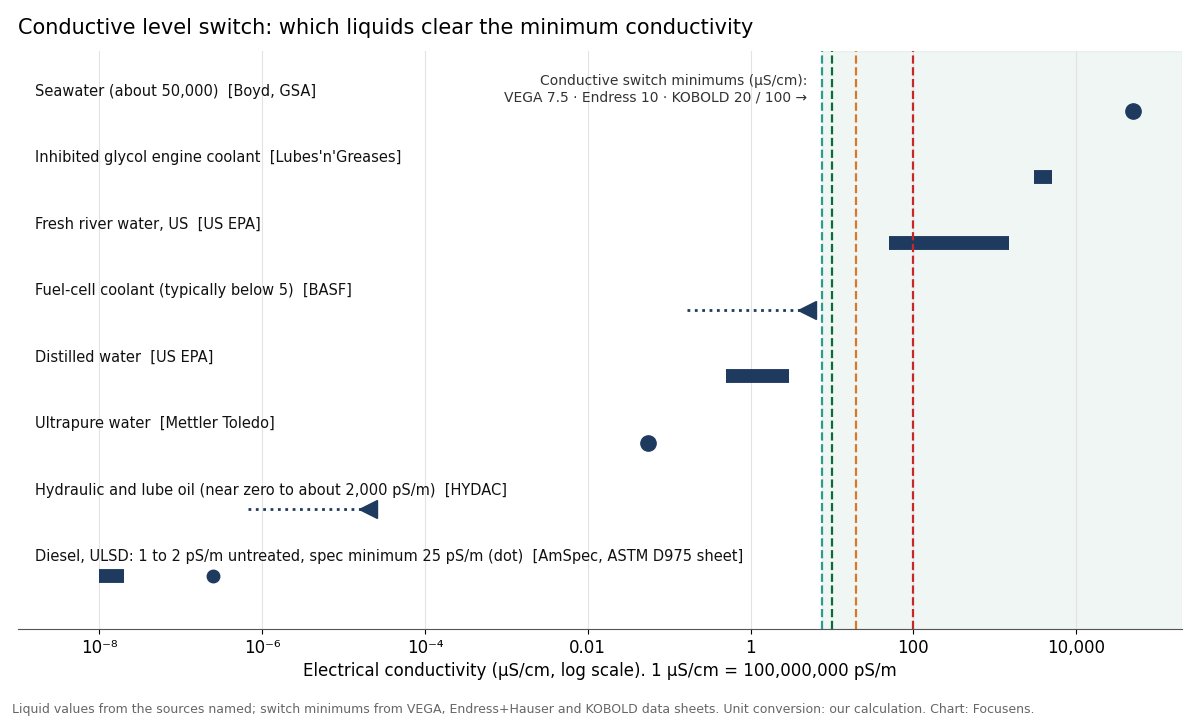
A conductive switch needs the liquid to carry a small current between its rods, so the deciding number is the liquid's conductivity. Published minimums from switch makers:
The table sets those minimums against what common liquids actually measure.
| Liquid | Typical conductivity | Conductive switch (7.5 to 100 µS/cm minimum) | Float switch with reed contact |
|---|---|---|---|
| Seawater | About 50,000 µS/cm (Boyd, Global Seafood Alliance) | Works | Works; choose a float and stem that resist salt water |
| Inhibited glycol engine coolant | 3,000 to 5,000 µS/cm (Lubes'n'Greases) | Works | Works |
| Fresh river water, US | 50 to 1,500 µS/cm (US EPA) | Works with 7.5 to 20 µS/cm switches; the low end is below a 100 µS/cm switch such as the KOBOLD NEK | Works |
| Fuel-cell coolant | Typically below 5 µS/cm (BASF Glysantin FC flyer) | Below every minimum listed | Works |
| Distilled water | 0.5 to 3 µS/cm (US EPA) | Below standard minimums; needs a special high-sensitivity relay | Works |
| Ultrapure water | 0.055 µS/cm (METTLER TOLEDO conductivity guide) | Below every minimum listed | Works |
| Hydraulic and lube oil | Near zero to about 2,000 pS/m (0.00002 µS/cm), read from HYDAC's chart of example oils (HYDAC white paper) | Does not work | Works if the float's material and minimum specific gravity suit the oil |
| Diesel (ULSD) | 1 to 2 pS/m before static-dissipater additive (AmSpec); at least 25 pS/m on an ASTM D975 ULSD spec sheet (example) | Does not work | Works with a fuel-rated float, for example NBR |
Conductivity units differ by industry. 1 µS/cm equals 100,000,000 pS/m. Diesel at the 25 pS/m ASTM D975 minimum is 80 million times below a 20 µS/cm switch minimum, and untreated diesel at 2 pS/m is a billion times below it (our calculation: 20 × 100,000,000 ÷ 25, and ÷ 2).
A conductive switch is a resistance threshold. The relay sees the liquid between the rods as a resistor, and it switches when that resistance drops below its sensitivity setting. Gems' rule for its Warrick relays is that "the sensitivity of the control (e.g. 10K, 26K etc.) should be greater than the resistance of the liquid", and that "the less conductive (more resistance) a liquid is, the more sensitive the control module needs to be" (Gems Warrick 16M configuration).

That has two practical consequences. First, size the switch for the lowest conductivity the process will see, not the average. KOBOLD notes that "conductivity can change with temperature and composition" (KOBOLD conductive level monitoring), and the USGS notes that electrical conductivity "increases by 0.5 to 3 percent per degree Celsius" (USGS TM 9-A6.3), so a liquid that clears the minimum when warm can drop below it when cold. Second, a sensitivity set too high causes its own fault: Gems warns that it "could sense mist, foam, steam, etc."
Most conductive relays drive their probes with alternating voltage. Endress+Hauser states that this "prevents corrosion of the probe rods and electrolytic destruction of the product". Omron shows what DC drive does: its DC-driven 61F-HSL model cannot be used for control where the electrodes are usually submerged, because of galvanic corrosion, and is limited to upper-limit alarms and leak detection (Omron FAQ). How the electrodes, relay and wiring work is covered in our electrode level sensor guide.
A float switch has the opposite requirement: the liquid does not need to conduct, but it has to be dense enough to lift the float. The minimum specific gravity is set by the float material and size, and float switch data sheets list it by model:
| Float | Minimum specific gravity of the liquid | Source |
|---|---|---|
| Buna-N (NBR) float, Gems LS-1700 | 0.45 | Gems LS-1700/1750 catalog page |
| 316 stainless float, Gems LS-1750 | 0.70 | same |
| PTFE float, Gems LS-1700 | 0.85 | same |
| Dwyer F7 floats, vertical and side mount | 0.45 to 0.90, by model | Dwyer F7 manual |
| Madison M4600, Buna-N float | 0.56 | Madison M4600 data sheet |
For comparison, diesel to the EN 590 standard has a density of 0.820 to 0.845 kg/L at 15 °C, and the ULSD spec sheet cited above lists a maximum of 0.876 kg/L. An NBR float rated for 0.45 or a 316 stainless float rated for 0.70 floats in either. A PTFE float rated for 0.85 will not lift in EN 590 diesel and is marginal in heavier US diesel, and a polypropylene float rated for 0.90, such as the Dwyer F7-MPP, will not lift in either (our comparison).
Three conditions defeat a float even when the density is right:
The reed contact is the other limit. Reed contacts are small: published ratings run from 10 VA (Dwyer F7-MPP) and 20 VA (Gems LS-1700) to 30 W (Madison M4010), 50 W (Dwyer F7-SB) and 100 VA (a Gems SPST option in RS Components' data sheet). Inrush current, and the voltage spike when a motor, solenoid or contactor coil switches off, can both weld the contact closed. Madison lists "In-rush current exceeds rating and welds switch closed" and "Voltage arcing during switching welds contacts closed" among its failure modes, recommends "general-purpose/isolation relays or controllers to protect the switch", and gives the suppression parts: for DC, a diode across the load rated at least three times the circuit voltage, and for typical 120 V AC circuits, "a 50 to 100 ohm, 1/2 watt Resistor in series with a .1 micro farad 400 to 600 volt capacitor across the switch" (Madison M4600 data sheet). How reed switches work is explained in our magnetic reed switch guide.
The two switch types fail in different ways, and the field check is different for each.
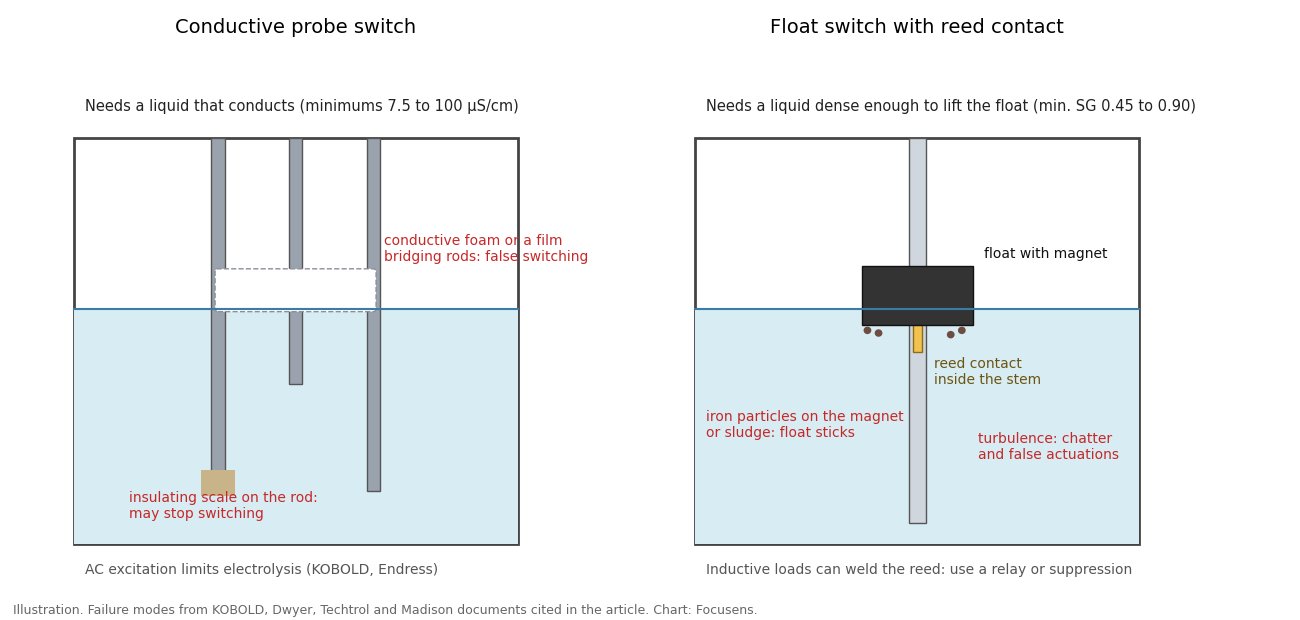
| Symptom | Likely cause, conductive switch | Likely cause, float switch | Check |
|---|---|---|---|
| Never switches with the tank full | Liquid below the minimum conductivity; insulating scale on the rods | Float stuck by sludge, grease or iron particles; float waterlogged | Conductive: jumper the probe terminals at the relay (Gems bench test). Float: lift the float by hand and check continuity |
| Switches when the tank is empty | Conductive foam, film or deposit bridging the rods | Float stuck in the raised position; contact welded closed | Conductive: clean the rods and reduce sensitivity. Float: continuity with the float down should match the NO or NC state on the label |
| Chatters or switches at random | Sensitivity too high; splashing | Turbulence or sloshing | Add a stilling tube or a time delay |
| Works, then fails later | Electrode corrosion, for example from a DC-driven probe | Contact worn by switching a load above its rating | Check the drive voltage; add an interposing relay for the load |
Sources for the checks: KOBOLD says that "insulating deposits, such as scale or crystallized material, can coat the electrode and prevent switching" and that "conductive deposits, product bridges, or conductive foam may cause premature or false switching" (KOBOLD). Gems' bench test places "a jumper between LLCO and G (Reference) contacts" to simulate liquid on the probes (Gems 26M bench test). Dwyer's float manual says "use an electrical continuity checker to determine if the switch is functional", and that a float "filled with liquid or has collapsed" means replacing the whole switch (Dwyer F7 installation manual).
One check trips people up on conductive relays: a handheld multimeter does not read the probe resistance the way the relay does. Omron's 61F FAQ explains that a DC meter cannot measure inter-electrode resistance accurately, and recommends measuring with the relay's own AC voltage (Omron FAQ).
Engine coolant. Ordinary inhibited glycol coolant is conductive enough for any conductive switch, at 3,000 to 5,000 µS/cm. Low-conductivity coolants are different. BASF specifies "typically <5 µS/cm" for fuel-cell cooling, below every minimum listed here, and battery-EV makers require coolant below 100 µS/cm (Lubes'n'Greases), so check the coolant data sheet before choosing a conductive switch. A float-and-reed coolant level sensor fails the way any reed float does. A float that has "filled with liquid or has collapsed" no longer rises (Dwyer F7 installation manual), so the switch reports a low level that is not there. Dwyer also notes that turbulence "will cause false actuations", so the controller should filter brief closures from sloshing with a time delay.
Distilled and deionized water. Distilled water at 0.5 to 3 µS/cm is below the standard minimums. Omron offers a high-sensitivity 61F model for 0.5 to 2 µS, but a float is usually the simpler choice, and KOBOLD lists "very pure water" among the liquids conductive switches cannot detect reliably.
Fuel and oil. Use a float switch for these. Even on-spec diesel at 25 pS/m is 80 million times less conductive than a 20 µS/cm conductive switch needs (our calculation). Pick a float material rated for the fluid; our fuel level float switch comparison covers fuel tanks.
Dirty liquids with high solids. These favor a conductive switch, if the liquid conducts. KOBOLD describes its NEK as having "no moving parts so it excels in dirty liquids with a high solids content" (KOBOLD NEK data sheet). A float in the same tank needs regular cleaning.
| Question | If yes | If no |
|---|---|---|
| Does the liquid conduct above the switch minimum (7.5 to 100 µS/cm) at its lowest point in the process? | Conductive or float both possible | Float switch (or a capacitive or ultrasonic sensor) |
| Is the liquid dense enough to lift the float (specific gravity above the float's minimum)? | Float possible | Conductive switch, or a larger, lighter float |
| Does the liquid carry iron particles or magnetic debris? | Avoid magnetic floats | Float possible |
| Does the liquid carry sludge or a high solids content? | Conductive (if it conducts), with a cleaning schedule for the rods | Either |
| Can grease, scale or crystals coat the sensor? | Neither is maintenance-free: insulating deposits stop a conductive switch and buildup sticks a float, so plan cleaning or consider a non-contact sensor | Either |
| Is there foam or conductive film above the level? | Float, or a conductive switch with reduced sensitivity | Either |
| Will the switch drive a pump, valve or contactor directly? | Add an interposing relay or suppression for a reed float | Either |
| Do you also need the liquid temperature? | A float switch with a built-in temperature sensor in the same stem | Either |
For floats that only indicate level without switching a circuit, see our guide to float level gauges and magnetic float level gauges.
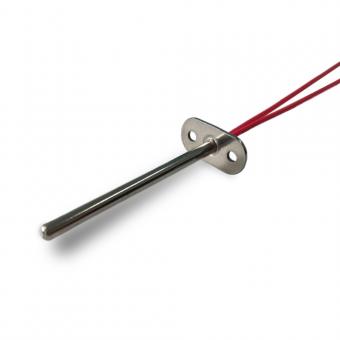
Focusens makes float level switches with reed contacts. We do not make conductive (electrode) probes. The range in our float level switch category includes:
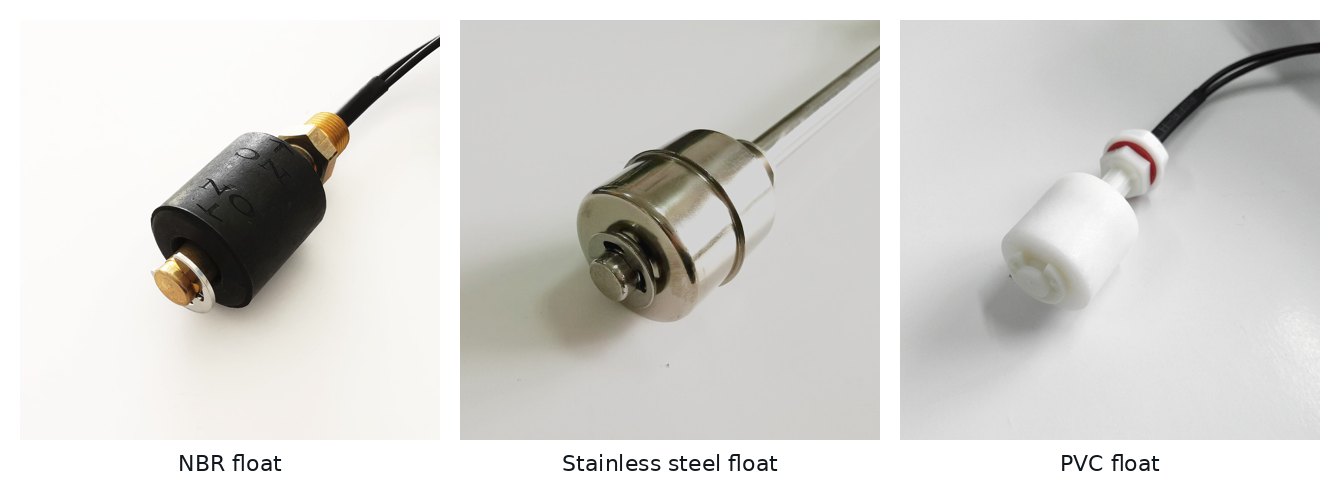
The contact rating, temperature range and minimum specific gravity depend on the reed and float fitted to your order, so ask for the data sheet for the part number before wiring it to a load. For a quote, contact our engineers with the liquid, its temperature, the tank connection, NO or NC, and the load the switch will drive.
A conductive level switch, also sold as a conductivity level switch or electrode level switch, detects liquid level by passing a small AC current between metal probe rods through the liquid. When the liquid touches the rods, the resistance between them drops and a relay switches. It only works in liquids that conduct, typically above 7.5 to 100 µS/cm depending on the model.
A conductive level switch cannot detect oil, fuel or most solvents. Oils measure in picosiemens per meter. Even the most conductive oil in HYDAC's examples, about 2,000 pS/m, is 375,000 times below a 7.5 µS/cm switch minimum (our calculation). KOBOLD states that "oils, fuels, most organic solvents, and very pure water generally cannot be detected reliably". Use a float switch or another non-conductive method.
A float switch works in diesel or oil if the liquid is dense enough to lift the float and the float material resists the fluid. Gems lists a minimum specific gravity of 0.45 for the Buna-N (NBR) float on its LS-1700 and 0.70 for the 316 stainless float on its LS-1750, but 0.90 for the stainless float on its LS-1755. Check the float's minimum against the fluid's specific gravity and its material against the fluid. Diesel to EN 590 is 0.820 to 0.845 kg/L at 15 °C, so it lifts the LS-1700 and LS-1750 floats but not reliably a PTFE float that needs 0.85, and not the LS-1755 float that needs 0.90.
A reed switch is the contact; a float switch is the assembly that moves it. In a magnetic float switch, a magnet inside the float opens or closes a reed switch sealed in the stem as the level changes. The reed switch never touches the liquid.
On a float switch with an SPDT reed contact, the three wires are common, normally open and normally closed; Gems lists SPDT 20 VA reed options for its floats. On a Focusens level and temperature float, the three wires are yellow for level, red for temperature and black for common, as shown on the product drawing.
A float switch usually stops working because the float is stuck (sludge, grease or iron particles on the magnet), the float has filled with liquid, or the reed contact has welded or burned from switching a load above its rating. Lift the float by hand and check continuity across the leads in both positions.
A reed float switch should not switch a pump motor directly unless its rating covers the motor's inrush current. The reed float switches in the data sheets cited here are rated 10 to 100 VA or W. Use the float switch to drive a relay or controller, and protect the contact with a diode across the load in DC circuits or a resistor-capacitor network across the switch in AC circuits.
Reviewed by the Focusens Engineering Team on October 17, 2026. Conductivity minimums, specific gravity limits, ratings and fault checks come from the KOBOLD, Endress+Hauser, VEGA, Gems, Dwyer, Madison, Techtrol and Omron documents linked beside each point; liquid conductivity values come from the US EPA, BASF, HYDAC and the other sources in the table. Unit conversions are our calculation.
No.1 XiSan Road, Electromechanical Industry Park , High&New Tech.Zone. Hefei,Anhui,China
tel : +86-551-69109668
Whatsapp : +86-13339100504
e-mail : info@focusens.com
Skype : melodyliu520






 +86-551-69109668